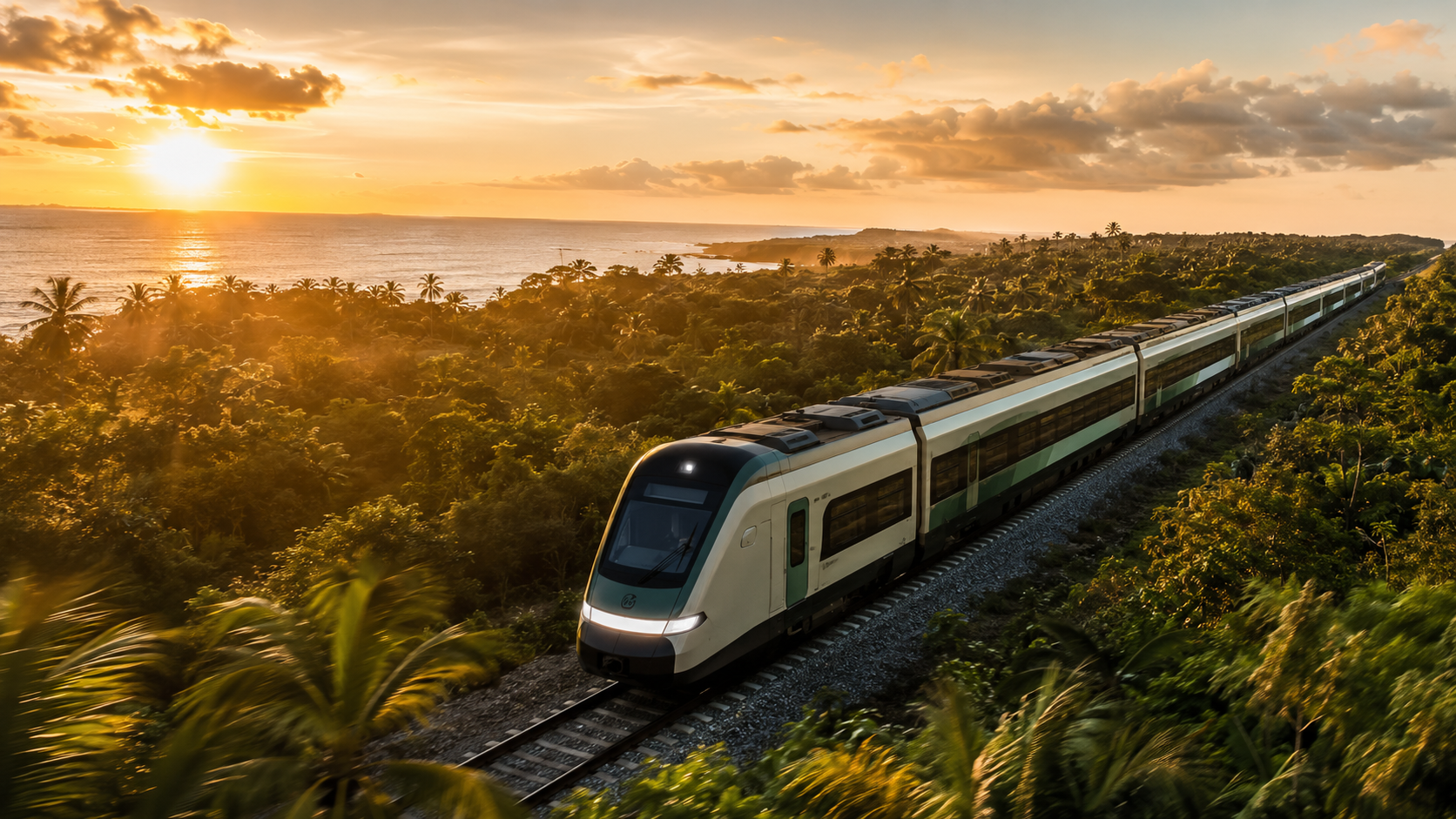
The Tren Maya is Mexico's new intercity railway that loops the entire Yucatán Peninsula, running from Palenque in Chiapas all the way around to Cancún, and for a traveler it means you can now hop between the region's biggest destinations without renting a car or hiring a private driver. In one connected system it links Cancún, Playa del Carmen, Puerto Morelos, Tulum, Valladolid, Chichén Itzá, Mérida, Campeche, Bacalar, and Palenque across 34 stops. The trains are modern, air-conditioned, and quick, with free WiFi, power outlets, and a top speed of 160 km/h. The one honest caveat: departures are still limited to a handful per day, so this is a train you plan around rather than show up and catch. Book ahead and build your route deliberately, and it becomes one of the easiest, most comfortable ways to see the peninsula.
The route and the key stations
The Tren Maya traces a giant loop around the Yucatán, with 34 stops in total: 20 major stations plus 14 smaller ones. On the Caribbean side it serves Cancún, Puerto Morelos, Playa del Carmen, and Tulum. Swing inland and it reaches Valladolid and a dedicated stop for Chichén Itzá, then the colonial capital of Mérida. From there the line continues to Campeche, drops south toward Bacalar and its lagoon of seven colors, and eventually crosses into Chiapas to finish at Palenque and its jungle ruins. The stretch that matters most for the classic Yucatán trip, the inland run linking Mérida and Tulum through Valladolid and Chichén Itzá, has been operating since 2024, so the corridor most travelers care about is live and running today.
How to buy tickets, the app, and fares
Buying a ticket is straightforward. The official channel is the "Tren Maya Tickets" app, which lets you check schedules, pick your seat, and pay from your phone, and there are ticket counters at the stations if you would rather buy in person. Fares come in tiers, with Turista, Nacional, Local, and Especial categories, so what you pay depends partly on which category applies to you. The single most useful thing to know is the "Plan Ahead" model: reserve well in advance, roughly 45 days or more before travel, and you can save up to 25 percent off the standard fare. Because seats and departures are limited, booking early locks in both a lower price and a guaranteed spot on the day you want to travel.
Turista vs Premier class
The trains offer two classes, and the difference is mostly about space and comfort. Turista class is the standard cabin, laid out in a 2-2 seating configuration, two seats on each side of the aisle, and it is perfectly comfortable for the journeys most visitors take. Premier class steps up to a roomier 2-1 layout, with just one seat on one side of the aisle, which means wider seats and more personal space. Both classes come with the same core amenities: free WiFi, power outlets at the seats, and full air-conditioning. For a short hop, Turista is more than enough; for a longer leg like Mérida to Palenque, the extra room in Premier is a nice upgrade if you want it.
Building a route: Cancún, Valladolid, Chichén Itzá, Mérida, Tulum, and Bacalar
The Tren Maya really shines when you use it to string destinations into a logical line instead of backtracking by car. A natural arc starts in Cancún, heads inland to Valladolid for its pastel streets and cenotes, pauses at Chichén Itzá for the great pyramid, and rolls on to Mérida for colonial architecture and Yucatecan food. From there you can loop back toward the coast at Tulum for ruins and beaches, or push south to Bacalar to float in its famous multi-colored lagoon. Because it is one connected network, you can design a trip that only ever moves forward, letting the train carry you and your luggage between anchors.
Honest advice: plan around the schedule
Here is the reality check. This is a young railway, and service is still thin. On the Cancún-to-Tulum corridor there are only around three departures per day in each direction, and other legs are similar. That is not a subway you can improvise around, so treat the Tren Maya like a flight: check the timetable first, then build your day around a specific departure. Confirm schedules in the app before you commit, arrive with a buffer, and have a backup for the "last mile" from station to hotel, since some stops sit outside the town center. Plan it properly and the limited frequency is a minor footnote; wing it and you can lose half a day waiting.
FAQ
Where does the Tren Maya go? It loops the Yucatán Peninsula from Palenque in Chiapas to Cancún, with 34 stops connecting Cancún, Playa del Carmen, Puerto Morelos, Tulum, Valladolid, Chichén Itzá, Mérida, Campeche, Bacalar, and Palenque.
How do I buy Tren Maya tickets? Through the official "Tren Maya Tickets" app or at station ticket counters. Fares come in Turista, Nacional, Local, and Especial tiers, and booking about 45 days ahead through the "Plan Ahead" model can save up to 25 percent.
How often do the trains run? Frequency is still limited, with only about three departures per day in each direction on the Cancún-Tulum corridor, so always check the schedule and plan around a specific departure.
What is the difference between Turista and Premier? Turista uses a 2-2 seat layout, while Premier offers a roomier 2-1 layout with wider seats. Both include free WiFi, power outlets, and air-conditioning.
As a local who lives and travels this region, Kev can help you decide when the train makes sense and when a car still wins, and stitch the Tren Maya into a smoother Yucatán route through Valladolid, Chichén Itzá, Mérida, Tulum, and Bacalar. Explore more inbound guides and start planning your journey here.