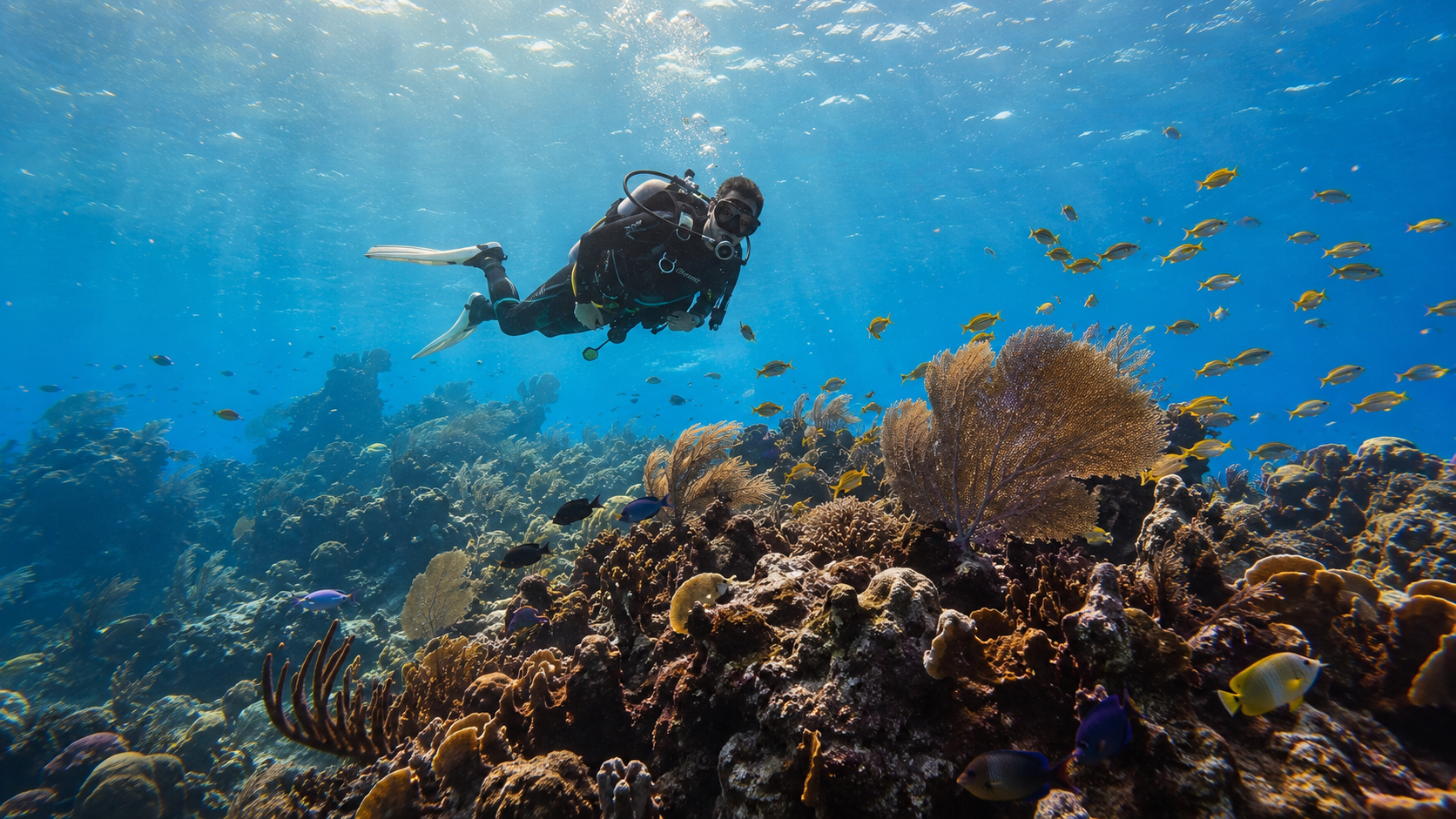
Cozumel is one of the best scuba diving destinations on the planet, and the reason is simple: it sits on the Mesoamerican Reef, the second-largest barrier reef system in the world, and the warm Caribbean current sweeps a river of clear water across its western walls every single day. That current is the secret. In Cozumel you don't fight the ocean, you fly with it. This is drift diving at its finest, where you drop in, relax, and let the sea carry you effortlessly along dramatic coral walls while visibility routinely exceeds 30 meters (100 feet). The water is bathtub-warm year-round, the reef is a protected national park, and the diving is genuinely world-class from your very first descent. If you're planning the Riviera Maya, a short ferry hop from Playa del Carmen puts you in the middle of it.
What Drift Diving Is (And Why Cozumel Does It Best)
In most of the world, you kick your way around a reef and back to the boat. In Cozumel, the current does the work. On a drift dive you simply enter the water, sink to your chosen depth, and glide along the wall as the Caribbean current pushes you gently forward. Your boat follows your bubbles from the surface, so there's no need to return to a fixed anchor point. The result is one of the most relaxed, low-effort, high-reward styles of diving anywhere, you cover huge stretches of reef while barely moving a fin.
Cozumel does it better than almost anywhere because of that famous visibility and warmth. The water clarity frequently tops 100 feet, revealing vibrant coral gardens, swim-throughs, and steep drop-offs in crisp detail. Because the island's reefs sit on the sheltered western side, conditions are consistent and predictable, ideal for a style of diving that rewards calm, current-aware technique.
The Top Dive Sites: Palancar, Santa Rosa Wall and Punta Sur
Palancar is the crown jewel and it comes in several flavors. Palancar Gardens is a gentle, coral-rich section suitable for all levels, while Palancar Caves offers a maze of tunnels, arches, and swim-throughs for those who want more adventure. Keep your eyes open here for eagle rays gliding by and nurse sharks resting under ledges.
Santa Rosa Wall is the classic Cozumel drift, a sheer vertical wall that plunges into the blue, draped in sponges and overhangs, with the current carrying you along like a moving sidewalk. It's a favorite for its consistency and its parade of marine life.
Punta Sur and Colombia sit at the more advanced end. Punta Sur is famous for the "Devil's Throat," a dramatic cavern swim-through that demands good buoyancy and nerve, while Colombia's Deep offers towering coral pinnacles and frequent turtle sightings. Together these sites make Cozumel a place you can dive for a week and never repeat yourself.
For Beginners vs. Advanced Divers
New to diving? Cozumel is a wonderful place to learn. Sites like Palancar Gardens, Paradise, and Chankanaab offer shallow, calm, high-visibility conditions where drift diving feels intuitive rather than intimidating. Dive operators run certification courses and guided intro dives daily.
Experienced divers get their reward at Punta Sur, Colombia Deep, and the Caves of Palancar, where stronger currents, swim-throughs, and greater depth call for confident buoyancy and comfort with drift technique. The beauty of Cozumel is that both ends of the spectrum share the same warm, clear water, so a mixed group can dive the same region on the same day.
The National Park and Conservation
Cozumel's reefs lie within the Arrecifes de Cozumel National Park, a protected marine reserve. That protection is why the coral is so healthy and the fish life so abundant. Every diver pays a modest park conservation fee, and the rules are strict for good reason: no touching or standing on coral, no gloves at many sites, and reef-safe sunscreen only. Diving here means diving with care, so the reef stays this spectacular for the next generation.
How to Get There and the Best Time to Dive
Cozumel is an island, reached by a scenic ferry from Playa del Carmen that takes roughly 45 minutes and runs frequently throughout the day. Most divers base themselves in Playa del Carmen or elsewhere along the Riviera Maya and either day-trip over or stay on the island itself.
You can dive Cozumel every month of the year, but the best time is November through May, when the water is at its clearest and calmest and visibility peaks. Summer and early fall are still excellent but coincide with hurricane season, so keep an eye on the forecast.
FAQ
Do I need diving experience to dive in Cozumel? No. Cozumel has plenty of shallow, calm sites perfect for beginners and certification courses, alongside advanced sites for experienced divers.
What makes Cozumel diving different? Drift diving. The Caribbean current carries you effortlessly along the reef walls, combined with visibility that frequently exceeds 100 feet and warm water year-round.
When is the best time to dive Cozumel? November through May offers the clearest, calmest water. Diving is possible all year, but watch the summer-fall hurricane season.
How do I get to Cozumel from Playa del Carmen? Take the passenger ferry, a roughly 45-minute crossing with frequent daily departures.
---
As your local guide, I plan Cozumel dive trips end to end, matching the right sites to your experience, timing your visit for the clearest water, and weaving the diving into the wider Riviera Maya. Start planning your Cozumel adventure with me.