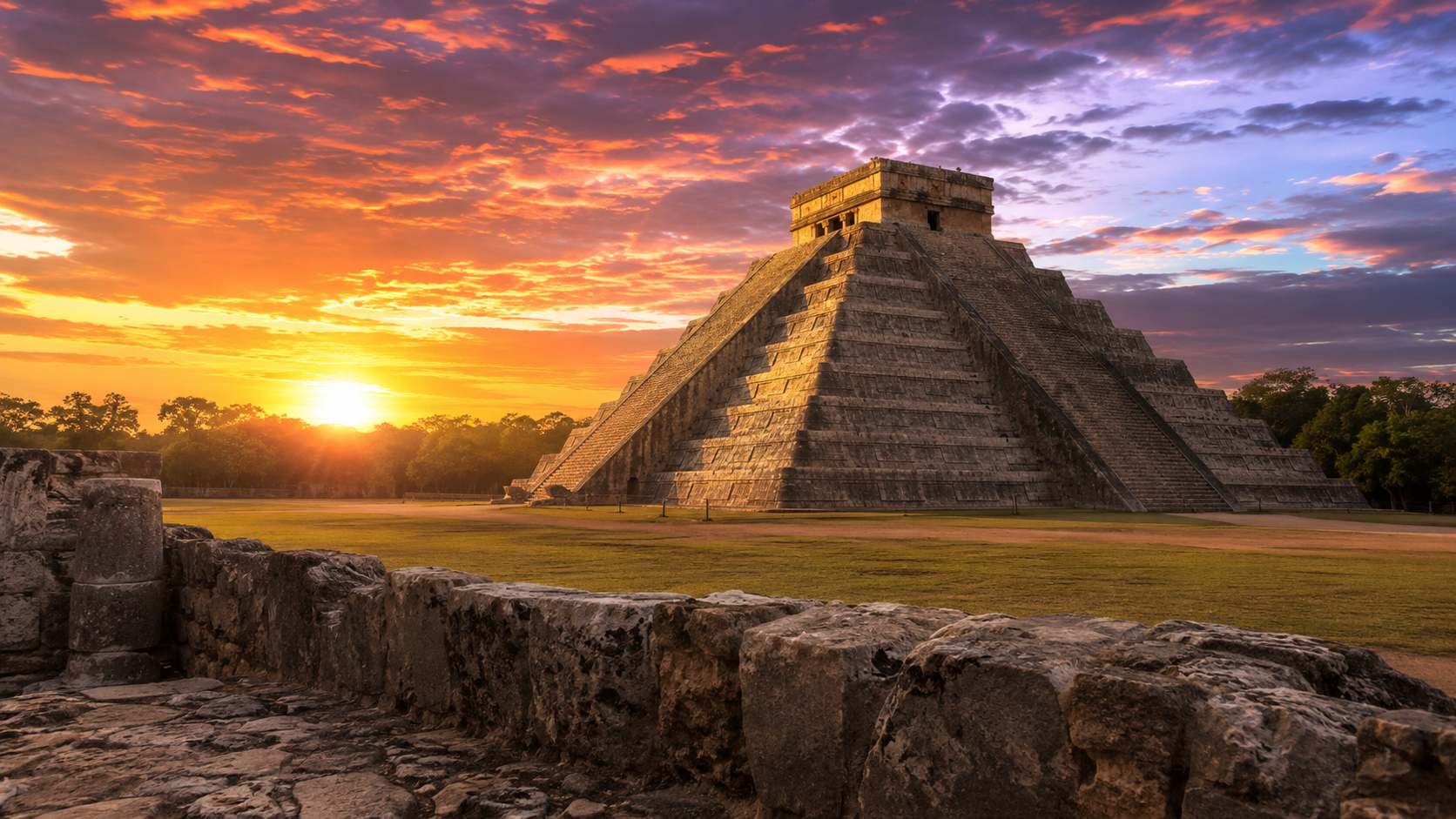
Chichén Itzá is the most important archaeological site in the Yucatán, a UNESCO World Heritage Site and one of the New Seven Wonders of the World, and the best way to visit it is simple: arrive right at opening. This vast ancient Maya city is crowned by El Castillo, the stepped pyramid of Kukulcán rising perfectly geometric from a wide grass plaza, and ringed by the largest ball court the Maya ever built, a sacred sinkhole once used for offerings, and an observatory that tracked the sky with astonishing precision. You cannot climb the pyramid anymore, so the reward here is atmosphere, scale, and history rather than a summit view. Get there early, walk it in the cool morning, and you will understand why this place stops travelers in their tracks.
El Castillo, Kukulcán, and the equinox serpent
El Castillo, also called the Temple of Kukulcán, is the icon on every postcard, and it is a calendar in stone: its four staircases have 91 steps each, which with the top platform total 365, one for every day of the year. Its most famous trick happens at the spring and autumn equinoxes. In the late afternoon, the stepped edges cast a rippling triangular shadow down the northern balustrade, and for a few minutes a serpent of light and shadow appears to slither down toward the carved stone snake heads at the base. It is Kukulcán, the feathered serpent, descending. The effect draws huge crowds around March 21 and September 21, though the alignment is visible for several days on either side if you want it with fewer people.
The other monuments you should not miss
Beyond El Castillo, Chichén Itzá is a full city worth an unhurried loop. The Great Ball Court is the largest in Mesoamerica, a walled field with acoustics so precise that a whisper carries end to end and a clap echoes cleanly off the temple walls. The Temple of the Warriors is fronted by a forest of carved columns and topped by a reclining Chac Mool. El Caracol, the round "snail" observatory, has windows that align with Venus and the equinox sun. Add the vast, murky Sacred Cenote, into which the Maya threw offerings of jade, gold, and human sacrifice, and you have a site that rewards a slow, curious walk.
Why you should arrive early
Chichén Itzá opens at 8 a.m., and being there when the gates open is the best decision you can make. Two things get worse as the morning goes on: the heat and the crowds. By 10 or 11 a.m. the tour buses from Cancún and the Riviera Maya arrive in waves, the plazas fill with groups, and the paths turn into a gauntlet of souvenir vendors laying out blankets and blowing jaguar whistles. The Yucatán sun is punishing by midday and there is little shade. Arrive at 8 and you get soft light for photos, cool air, quiet around El Castillo, and an hour or two of the ruins almost to yourself before the day-trippers descend.
How to get there from Cancún, Mérida, or Valladolid
Chichén Itzá sits almost exactly between Cancún and Mérida, and where you start shapes your day. From Cancún or the Riviera Maya it is roughly two and a half to three hours each way by car on the toll highway, so most people rent a car, take the ADO bus, or join a tour. From Mérida it is about an hour and a half west, an easy day trip. The smartest base of all is Valladolid, the colonial town just 45 minutes east: sleep there, drive out for the 8 a.m. opening, and you will beat every bus coming from the coast. Renting a car gives you that early-arrival freedom that tours, which show up mid-morning, cannot.
Combine it with Cenote Ik Kil and Valladolid
The classic pairing is Chichén Itzá plus a cenote to cool off afterward, and Cenote Ik Kil is right around the corner, only about five minutes from the ruins. It is a spectacular open-air sinkhole with vines and roots cascading 25 meters down to a deep circular pool, and a swim there after a hot morning is the perfect reset. From there, Valladolid is a short drive east and makes an ideal lunch and afternoon stop, with its pastel streets, its own in-town cenotes, and excellent Yucatecan food. Ruins at dawn, cenote at midday, colonial town in the afternoon: that is a near-perfect day.
Practical tips
Bring more water than you think you need, wear a hat and real sun protection, and put on comfortable shoes for the uneven stone paths. Remember there is no climbing El Castillo, so do not plan around a summit photo. A licensed guide at the entrance brings the carvings and legends to life if history matters to you. Carry small bills for entrance and parking, and note the site closes in the late afternoon, so an early start also spares you a rushed exit.
FAQ
Can you climb the pyramid at Chichén Itzá? No. Climbing El Castillo has been prohibited for years to protect the structure. For a pyramid you can still climb, visit nearby Ek Balam or Cobá.
What time should you arrive at Chichén Itzá? Right at the 8 a.m. opening. Early arrival means cooler temperatures, softer light, thinner crowds, and quiet before the tour buses arrive mid-morning.
How long do you need at Chichén Itzá? Plan on two to three hours to see the main monuments at a comfortable pace, plus travel time and an optional cenote swim afterward.
When is the equinox serpent visible? Around the spring equinox (about March 21) and the autumn equinox (about September 21), in the late afternoon, with a similar effect visible for a few days on either side.
As a local guide who lives and travels this region, Kev can help you time Chichén Itzá right and stitch it into a smoother Yucatán route with Ik Kil, Valladolid, and the cenotes. Explore more inbound guides and start planning your journey here.